Hyper-parameters
| Parameter | Meaning | Typical values |
|---|---|---|
n_clauses |
clauses per class (flat/conv) or shared clauses (coalesced) | 20 (XOR) … 2000–8000 (MNIST) |
T |
vote margin: how many net votes a class should reach | ≈ 0.5–2 × clauses/class for flat, up to 10 × for convolutional |
s |
specificity: 1/s forget probability |
2–4 for small/tabular, 5–15 for images, 2–8 for text |
n_states |
memory depth N per action |
50–128 (256 states); deeper = slower forgetting |
boost_true_positive |
deterministic memorisation of True literals | True |
weighted |
integer clause weights | True for images, often False for tiny problems |
max_included_literals |
clause size budget (soft by default; budget_mode) |
8–32 for concise rules |
drop_clause_p |
fraction of clauses dropped per batch/epoch | 0.25 (images) – 0.75 (text) |
focused_negative_sampling |
pick confusable negative classes | True for many classes |
feedback_mode |
"batch" or "sequential" |
"batch" with batch size 8–64 |
Reference configurations from the literature:
| Task | clauses | T | s | notes |
|---|---|---|---|---|
| Noisy XOR (12 bits) | 20 | 15 | 3.9 | 100 states, ~200 epochs |
| MNIST, flat | 2000/class | 50 | 10 | pixel > 0.3, 256 states, 400 epochs |
| MNIST, conv 10×10 | 8000/class | 10 000 | 5 | weighted, adaptive Gaussian threshold |
| Fashion-MNIST, conv 10×10 | 8000/class | 10 000 | 10 | weighted |
| CIFAR-10, conv 3×3 colour thermometer | 2000/class | 1500 | 2.5 | composites |
| IMDb bag-of-words | 10 000 | 8000 | 2.0 | drop clause 0.75 |
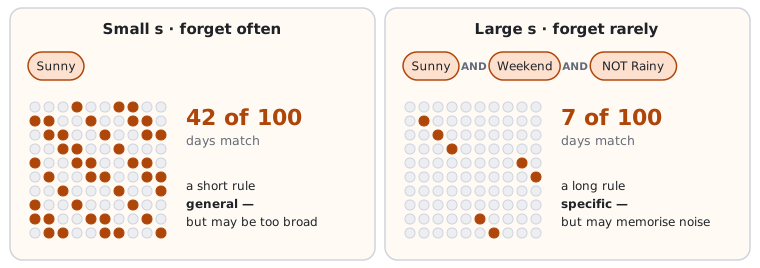
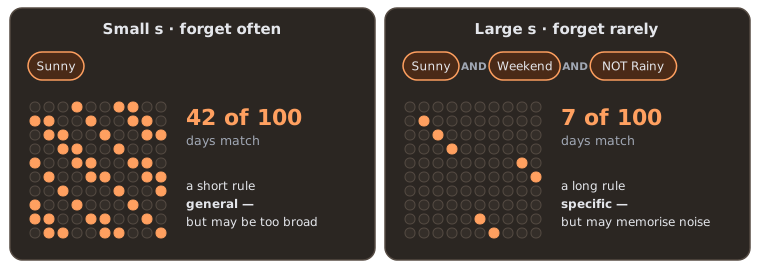
s. Literals that do not help are forgotten with probability 1/s: a small s keeps rules short and general, a large s lets them grow long and specific.What each core parameter does, from the Markov-chain analysis in Why a Tsetlin machine learns what it learns:
sis a frequency threshold: a literal stays in a clause roughly when it is true in more than1/sof the examples that train the clause.n_statessets how sharp each include/exclude decision is: every extra state makes the automaton exponentially more likely to sit firmly on one side.Tmakes clauses divide the work: without a margin, clauses for the same class converge to the same pattern.
Rules of thumb:
- Raise
Ttogether with the number of clauses; the ratio matters more than either value. - If clauses stay empty or tiny, raise
s; if they memorise noise, lowers. - Use
HyperparameterScheduleto annealsor growdrop_clause_pover epochs. - Track
model.state_summary()(mean included literals, empty clauses) withStateSummaryLogger.