Booleanization
Tsetlin machines consume Boolean features. Turning raw data into Booleans is the single most
important modelling decision, because the literals are the vocabulary of the learned rules.
torchtsetlin.data provides encoders that follow the scikit-learn fit / transform
protocol and are nn.Modules (they move to the GPU and are saved in state_dict()).
Continuous features: thermometer encoding
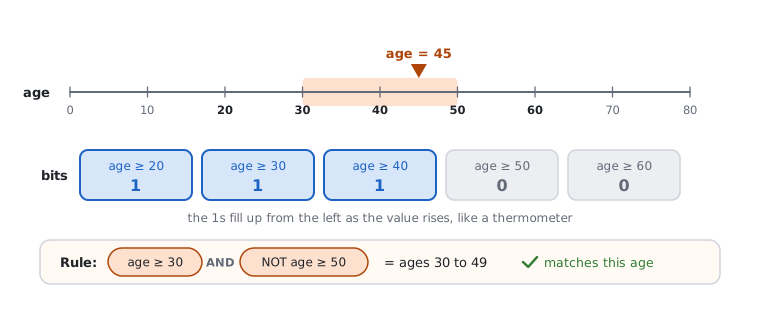
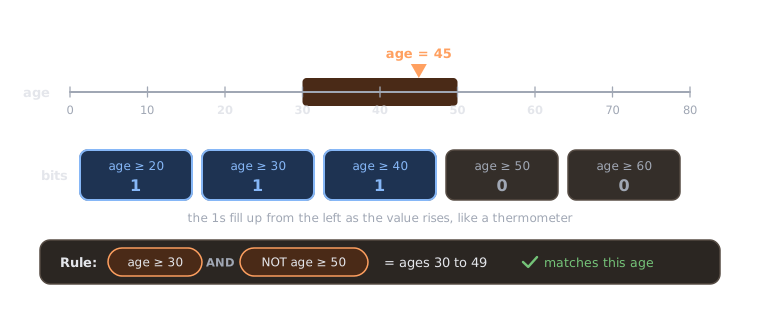
ThermometerEncoder(n_bits, strategy) turns each value v into bits [v >= t_1, …, v >= t_n]
for increasing thresholds. Two literals then express a range: age>=30 AND NOT age>=50.
enc = tt.data.ThermometerEncoder(n_bits=8, strategy="quantile").fit(x_train_float)
xb = enc(x_train_float)                       # (N, F * 8) bool
model.feature_names = enc.feature_names(column_names)   # readable rules
Strategies: "quantile" (equal-frequency, robust default), "uniform" (equal-width, pass
value_range=(0, 255) for images), "unique" (evenly spaced ranks of the unique training
values, like tmu's StandardBinarizer).
Categorical features
OneHotEncoder produces one Boolean per category (menopause=ge40), as in the book's breast
cancer example. BitPlaneEncoder gives the binary digits of integers when you want compact
codes (even numbers are NOT bit0).
Images
Binarizer(0.3)— fixed threshold (the original MNIST recipe:pixel > 0.3).AdaptiveThresholdEncoder(block_size=11, C=2, method="gaussian")— local thresholding (OpenCV'sADAPTIVE_THRESH_GAUSSIAN_C), used for MNIST/Fashion-MNIST in the convolutional TM papers.ColorThermometerEncoder(n_bits=8)— per-channel thermometer,(N, 3, H, W)→(N, 24, H, W), the standard CIFAR encoding for TM composites.BitPlaneEncoder(8)— 8 place-value planes per channel.
load_mnist_boolean / load_torchvision_boolean apply any of these to a torchvision
dataset and return Boolean tensors ready for the GPU.
Text and sets
Bag-of-words presence bits are the classical text encoding. HypervectorEncoder maps
token ids to sparse random hypervectors and bundles them with OR (optionally binding word
position with a cyclic shift), a compact alternative for large vocabularies.
Composition
pipeline = tt.data.Compose(tt.data.ThermometerEncoder(4), tt.data.Flatten())
xb = pipeline.fit_transform(x)
pipeline.output_size(n_columns)
Decoding rules
ThermometerEncoder.decode_range and ConvTsetlinMachine.clause_region translate included
bits back to intervals, and interpret.aggregate_literal_importance sums literal
importances over the bits of one original feature.