Batched vs sequential feedback
The classical Tsetlin machine processes one example at a time: evaluate the clauses,
give feedback, update the automata, move on. On a GPU that leaves most of the hardware idle,
so torchtsetlin offers two ways to consume a mini-batch.
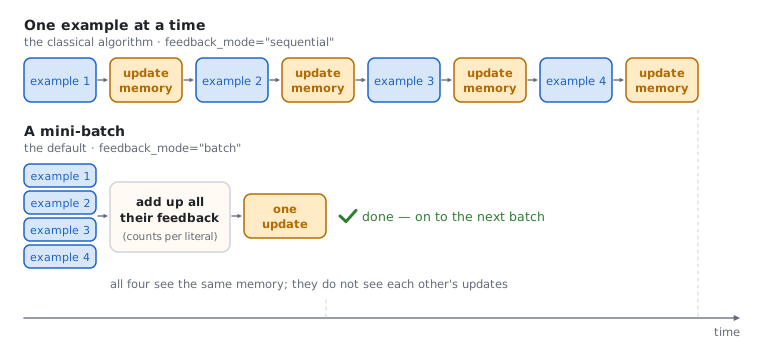
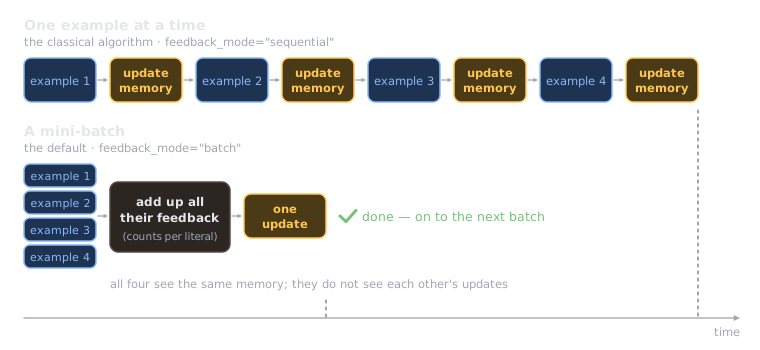
feedback_mode="batch" (default)
All B examples of the batch are evaluated against the current automata. For every
(example, clause) pair the algorithm decides whether the clause gets Type I or Type II
feedback exactly as in the sequential algorithm. The resulting feedback events are then
counted per (clause, literal):
n_true[j, k]— Type Ia events where literalkwas True (memorise candidates),n_false[j, k]— Type Ia events where literalkwas False (forget candidates),n_ib[j]— Type Ib events (forget everything),n2[j, k]— Type II events where literalkwas False.
These counts are two small matrix products, and the stochastic transitions become
binomial draws: Binomial(n_true, (s-1)/s) increments, Binomial(n_false + n_ib, 1/s)
decrements, and min(n2, N - state) deterministic Type II increments (an automaton is never
pushed past the include boundary by Type II, exactly as in the sequential algorithm where the
clause stops matching once a literal is included). The automata are updated once per batch.
With B = 1 this is the classical algorithm. For B > 1 it is an approximation in the same
sense as mini-batch SGD: the examples of a batch do not see each other's updates. Empirically
(Noisy XOR, 20 clauses, T=15, s=3.9, N=50, 2000 training examples, 3 seeds):
| batch size | epochs | updates | test accuracy |
|---|---|---|---|
| 1 (sequential) | 40 | 80 000 | 0.95 – 0.99 |
| 10 | 100 | 20 000 | 0.93 – 0.99 |
| 50 | 200 | 8 000 | 0.88 – 0.99 |
| 200 | 400 | 4 000 | 0.77 – 0.89 |
Small and medium batches (≈ 8–64) keep the accuracy of the sequential algorithm while running one to two orders of magnitude faster on a GPU; very large batches need more epochs. Clause weights (weighted and coalesced models) change by at most the number of events in the batch, so also prefer moderate batch sizes there.
feedback_mode="sequential"
model = tt.TsetlinMachine(..., feedback_mode="sequential")
# or per call
model.update(x, y, sequential=True)
Examples are processed one by one (still vectorised over all clauses and literals, so it is fast for large models on a GPU, just not as fast as batching). Use it when you want the exact reference dynamics, for small data, or to validate a batched configuration.
Chunking
Independently of the feedback mode, a batch is split into chunks so that the intermediate
tensors ((chunk, patches, clauses) for convolutional models) respect
max_chunk_elements. Chunking never changes the result of a batched update; it only bounds
memory.
Practical guidance
- Start with a batch size of 16–64 for flat models and 8–32 for convolutional models.
- If accuracy lags the sequential algorithm, halve the batch size or increase the number of
epochs before touching
Tands. - The
update()return value (vote sums before the update) gives you a free running training accuracy; theTrainerlogs it asbatch_accuracy.